When you’re learning Dutch, it’s tempting to think in English first and then translate. But that slows you down and often makes your Dutch sound unnatural.
Think of words like gezellig (“cosy”, “fun”) or lekker (“tasty”, “nice”, “comfortable”). Or expressions like oude koeien uit de sloot halen (“bringing up old problems”). In English you “dig up old bones”, but in Dutch you literally “get the cows out of the ditch”. There’s no one-to-one translation for these!
Instead of translating word-for-word, it helps to notice different categories of Dutch words and phrases which you cannot translate literally. Here are some examples.
1. Same idea, different verbs
Some Dutch phrases exist in English, but the grammar is different:
- Ik heb honger = “I am hungry” (literally: “I have hunger”).
- Ik heb dorst = “I am thirsty” (literally: “I have thirst)
- Ik heb haast = “I am in a hurry” (literally: “I have hurry”).
- Die trui staat je goed = “The sweater looks nice on you.” (literally: It stands you good.)
- De vaas staat op tafel = “The vase is on the table.” (literally: It is standing on the table.) Note: In Dutch we use very precise position verbs.
2. Verbs that don’t match
In English, you “play football” or “play tennis”. But in Dutch, sports don’t use the verb spelen (“to play”). Instead, the sport itself is the verb.
- voetballen = to play football
- tennissen = to play tennis
- hockeyen = to play hockey
- squashen = to play squash
These are conjugated like regular verbs: ik voetbal, jij voetbalt, hij/ zij voetbalt …..
3. Truly Dutch words
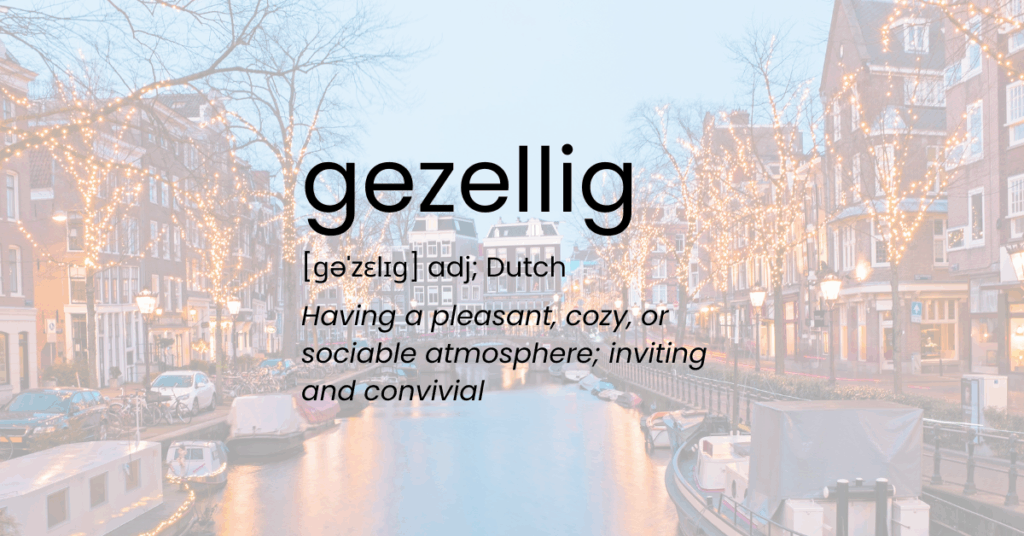
- Gezellig = a cosy, friendly, pleasant atmosphere.
- Uitwaaien = going outside (often to the beach or park) to get fresh air and clear your head, literally “to blow out.”
- Uitzwaaien = to wave goodbye
- De koukleum = a person who always feels cold.
- IJsberen = to pace up and down a room when you are feeling worried – ‘een ijsbeer is a polar bear’
- Lekker = “tasty”, but much much more! It’s about anything that feels good.
- lekker eten = tasty food
- lekker weer = nice weather
- lekker slapen = sleep well
- een lekkere vakantie = comfortably lazy
- een lekkere stoel = a comfortable chair
4. Expressions and phrases you can’t translate literally
Dutch expressions often sound funny in English, but they also reveal something about Dutch culture and values:
- Oude koeien uit de sloot halen = “to bring up old problems” (literally: “to drag old cows out of the ditch”).
- A farming image that reflects Dutch agricultural life.
- Doe maar gewoon, dan doe je al gek genoeg = “Just act normal, that’s crazy enough.”
- The Dutch love modesty and don’t like people showing off.
- Maak je niet druk = “Don’t worry” (literally: “Don’t make yourself busy.”)
- A very down-to-earth way of saying: relax, it’s not a big deal.
- Het komt wel goed = “It will be fine.”
- This shows the Dutch calm, practical attitude… don’t panic, it will work out!
- Ik heb nog wel een gaatje in mijn agenda = “I still have availability in my calendar.” (literally: “I still have a free hole in my agenda.”).
- Dutch people plan their time carefully and don’t want to waste their time. Therefore an ‘agenda’ is very important for Dutch people. If we make an appointment, we write it down in our calendars and stick to it.
5. Specific words for people
Dutch and English don’t always match in how they describe family and neighbours. Sometimes Dutch has fewer words than English (for cousins, nieces, nephews). In other cases, Dutch is more precise (distinguishing gezin and familie, or giving gender/age for neighbours).
Neighbours
- buurman = male neighbour
- buurvrouw = female neighbour
- buurmeisje = neighbour girl
- buurjongen = neighbour boy
Family
- het gezin = the people you live with (parents, children).
- de familie = your wider family (aunts, uncles, cousins).
- neef / nicht = can mean cousin, nephew, or niece depending on context.
- neefje / nichtje = specifically nephew or niece; ‘neefje’ is a diminutive of ‘neef’.
- broers en zussen = siblings (there’s no real Dutch equivalent to the English word “siblings”, so we just say “brothers and sisters”)
6. Birthdays the Dutch way
- de verjaardag = the birthday.
- Ik ben jarig = “It’s my birthday” (literally: “I am birthday-ish”). The adjective jarig doesn’t exist in English!
- de kringverjaardag = a “circle birthday”, which is a Dutch tradition where guests sit in a circle, drink coffee, eat cake, and congratulate not only the birthday person but also their family.
7. Food & drink culture
Dutch has some wonderful words around eating and drinking that don’t translate easily:
- De borrel is not just a drink, but the whole social event of having drinks and snacks together.
- Ik geef een borrel = I’m hosting drinks.
- borrelen = having drinks together.
- de borrelplank = snack platter.
- borrelhapjes = small bites served with drinks.
- Natafelen = staying at the table after the meal is finished, talking and enjoying each other’s company. English has no single word for this, but it’s a very Dutch habit.
Why use these untranslatable Dutch words?
Dutch words and expressions don’t always translate neatly into English. But that’s exactly what makes them interesting: they reflect Dutch life and culture. So instead of translating word-for-word, try to learn Dutch the way it’s really used. You’ll sound more natural, understand more traditions, and feel a little closer to Dutch culture, and that’s pretty gezellig.
 You can learn more about my Dutch course options, or contact me for more information. I would also encourage you to sign up to receive my newsletter in which I share updates and exclusive Dutch learning content for expats! If you want to get to know me and my teaching style first, you are welcome to check out student testimonials or book a free intake session!
0 Comments