
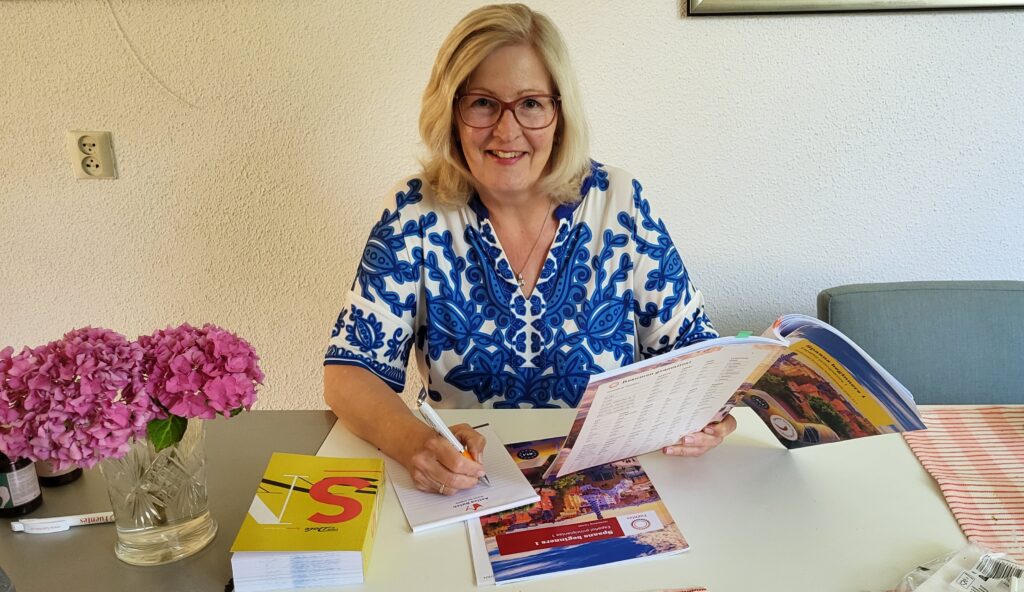
I recently embarked on a new adventure – learning Spanish! Every Friday morning, I find myself back in the student seat, diligently practicing basic conversations and grappling with verb conjugations and adjective endings. Being a language teacher myself, it’s an interesting experience to be a part of language learning from the other side once again! I’m happy to say that even after just a few lessons, I was already surprised at how quickly I could introduce myself and ask simple questions.
As I dive into learning Spanish, I’ve gained a deeper understanding of why certain aspects of Dutch grammar might be particularly challenging for those who speak Spanish. For example, forming questions in Dutch involves a different word order, which can be confusing for those used to Spanish sentence construction. This experience has heightened my appreciation for the similarities and unique nuances of each language. The more languages I explore, the more I admire their beauty and complexity, and the more I empathize with my students and improve as a teacher.
Today, I’ll share ten challenging Dutch sentences and phrases that often leave even my more advanced learners scratching their heads…
My Top 10 Challenging Dutch Phrases
Dutch Challenge 1
🇳🇱 “Ik ben het ermee eens.” (🇬🇧 I agree.)
🇳🇱 “Ik ben het er niet mee eens.” (🇬🇧 I disagree.)
In Dutch you need a lot of words to say that you agree compared to English. “Het met iemand eens zijn” means that you agree with someone. In this sentence you need the word “er”, which refers to what you agree about. And the preposition “met” changes in combination with the word “er” into “mee”.
Dutch Challenge 2
🇳🇱 “Ik heb zin in een wijntje.” (🇬🇧 I’m in the mood for a glass of wine.)
The phrase “zin hebben in ____” can be used with other nouns as well. For example: “Ik heb zin in vakantie.” (I’m looking forward to the holidays.)
Dutch Challenge 3
🇳🇱 “Waar heb jij een hekel aan?” (🇬🇧 What do you hate?)
The question word “waar” means “what” in this case. “Aan wat” changes into “Waar… aan”, because the phrase “een hekel hebben” is used in combination with the preposition “aan”.
Dutch Challenge 4
🇳🇱 “Ik kan me mijn jeugd nog goed herinneren.” (🇬🇧 I can remember my youth very well.)
“To remember” is a so-called reflexive verb in Dutch, so it needs the extra word “me”.
Dutch Challenge 5
🇳🇱 “Het hangt ervan af.” (🇬🇧 It depends.)
🇳🇱 “Het hangt af van het weer.” (🇬🇧 It depends on the weather.)
The infinitive is “afhangen van”. The word “er” refers to something in the previous sentence.
Dutch Challenge 6
🇳🇱 “Ik ga naar mijn/het werk.” (🇬🇧 I’m going to work.)
🇳🇱 “Ik ga naar kantoor.” (🇬🇧 I’m going to the office.)
You cannot say “ik ga naar werk” in Dutch. However with the word “kantoor” you don’t use an article.
Dutch Challenge 7
🇳🇱 “[Het examen] viel mee.” (🇬🇧 [The exam] was easier than expected.)
🇳🇱 “[Het examen] viel tegen.” (🇬🇧 [The exam] was more difficult than expected.)
“Meevallen” is a separable verb consisting of the prefix “mee” and the verb “vallen”. “Viel” is the past tense of the verb “vallen”, but there is no verb in English which means the same thing!
Dutch Challenge 8
🇳🇱 “Ken jij je buren?” (🇬🇧 Do you know your neighbours?)
🇳🇱 “Weet jij waar het station is?” (🇬🇧 Do you know where the station is?)
The verbs “kennen” and “weten“ can both be translated as “to know” in English. The verb “kennen” is used for people, while the verb “weten” can be followed by a subclause (“….waar het station is.”)
Dutch Challenge 9
🇳🇱 “Woon jij liever in een huis of in een appartement?” (🇬🇧 Do you prefer living in a house or in an apartement?)
The word “liever” must be combined with a verb and means “prefer” in English. So the sentence “Ik liever in een huis.” would be incorrect.
Dutch Challenge 10
🇳🇱 “meegaan” (🇬🇧 “join me”)
🇳🇱 “meedoen” (🇬🇧 “join in”)
🇳🇱 “mee-eten” (🇬🇧 “eat together”)
🇳🇱 “meehelpen” (🇬🇧 “help out”)
The prefix “mee” means “met iemand of iets” (together). It can be combined with lots of verbs. There are no single English verbs that capture the full meaning of these verbs!
Here are a few examples in sentences below.
“We gaan vanavond naar de film. Ga je mee?”
“Mag ik met jullie meedoen?”
“Blijven jullie gezellig mee-eten!”
“Mijn man wil graag meehelpen in de huishouding.”
Note: all these verbs are separable verbs, consisting of the prefix “mee” + verb (doen, eten, helpen …)
 You can learn more about my Dutch course options, or contact me for more information. I would also encourage you to sign up to receive my newsletter in which I share updates and exclusive Dutch learning content for expats! If you want to get to know me and my teaching style first, you are welcome to check out student testimonials or book a free intake session!
0 Comments